
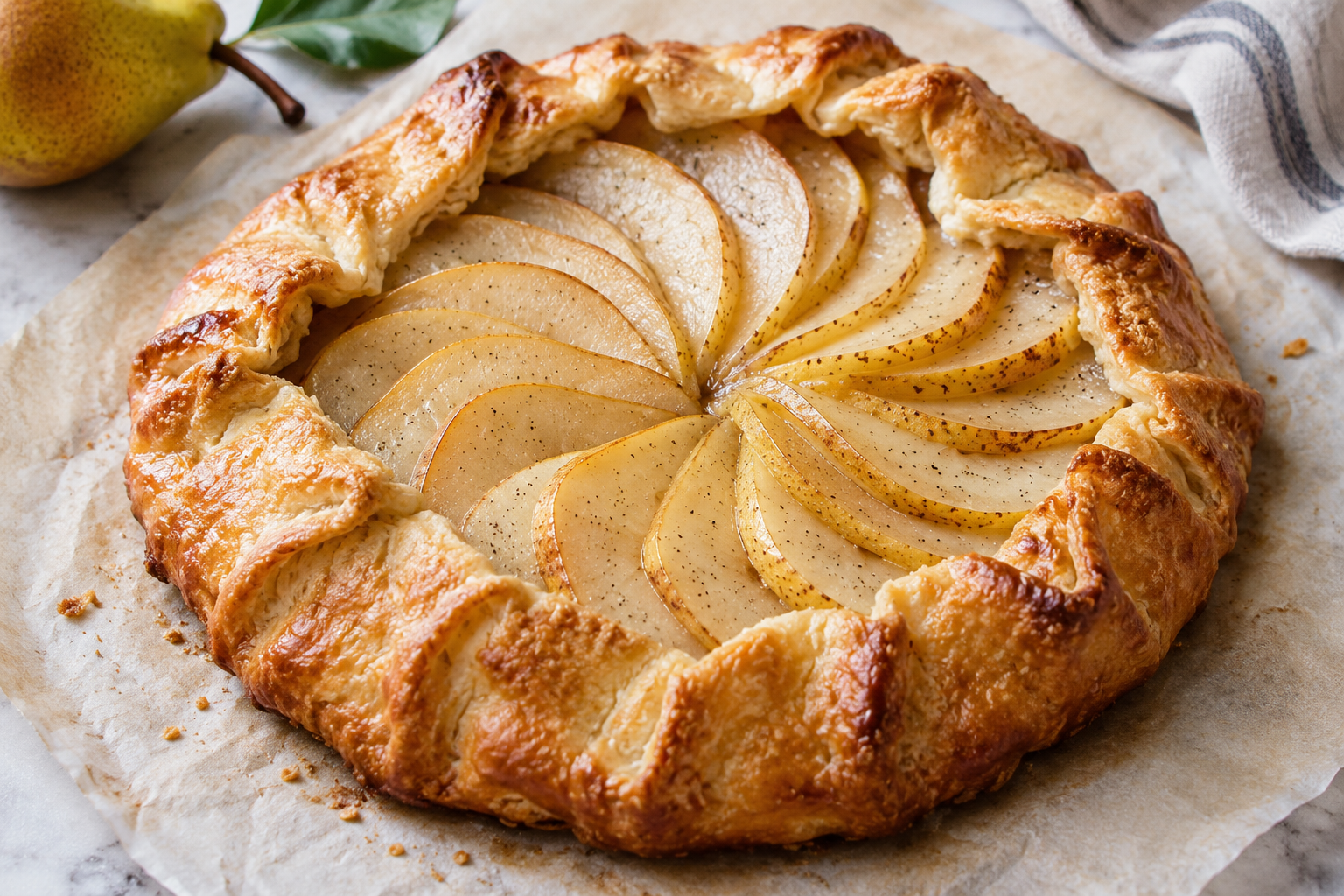
This vanilla pear galette has a flaky folded crust and a simple filling of thinly sliced pears scented with vanilla. You do not need a tart tin: assemble it on parchment, fold the pastry around the fruit and bake until the crust is deeply golden.

Jump to Ingredients · Jump to Recipe
Recipe at a Glance
- Yield: 8 slices
- Preparation: 30 minutes
- Cooking: 40–50 minutes
- Chilling: 1 hour for the dough, plus 15 minutes after assembly
Table of Contents
- Ingredients
- Before You Start
- Directions
- Cook’s Tips
- Storage and Make-Ahead
- Recipe Questions
- More Recipes You’ll Love
Ingredients
Pastry
- 190 g all-purpose flour, plus a little for rolling
- 15 g granulated sugar
- 1/4 teaspoon fine salt
- 115 g cold unsalted butter, cubed
- 45–60 ml ice water
Pear filling
- 3 medium firm-ripe pears (about 450 g after coring), thinly sliced
- 45 g granulated sugar
- 1 tablespoon cornstarch
- 1 teaspoon vanilla bean paste or vanilla extract
- 1 teaspoon lemon juice
To finish
- 1 egg beaten with 1 teaspoon water
- 1 tablespoon coarse sugar, optional
Before You Start
Choose pears that yield slightly at the neck but still hold their shape. Very ripe pears release more juice and can make the pastry soggy.
Read the full method before starting. Measure the ingredients, prepare the pan or baking sheets, and allow time for the cooling and chilling stages. The stated baking times are a guide; use the visual cues in the directions to judge doneness.
Directions
1. Make the pastry
Mix the flour, sugar and salt. Cut or rub in the cold butter, leaving a few pea-sized pieces. Add 45 ml ice water and toss with a fork. Add more water, 1 teaspoon at a time, only until the dough holds together when squeezed. Press into a disk, wrap and refrigerate for 1 hour.
2. Prepare the fruit
Line a large baking sheet with parchment. Core the pears and slice about 3 mm thick; peel if you prefer. Toss gently with the sugar, cornstarch, vanilla and lemon juice just before assembling.
3. Roll and fill
Roll the dough on a lightly floured surface into a 30 cm (12-inch) circle about 3 mm thick. Transfer to the prepared baking sheet. Arrange the pears in the center, leaving a 5 cm border. Leave any excess thin juice in the bowl. Fold the dough border over the outer pears, pleating as you go.
4. Chill and finish
Refrigerate the assembled galette for 15 minutes while heating the oven to 200°C (400°F). Brush only the exposed pastry with egg wash and sprinkle with coarse sugar if using.
5. Bake
Bake for 40–50 minutes, until the crust is deeply golden, including the underside, and the pears are tender with bubbling juices. Tent the edge with foil if necessary. Cool on the baking sheet for at least 20 minutes before sliding onto a serving plate and slicing.
Cook’s Tips
- Choose pears that yield slightly at the neck but still hold their shape. Very ripe pears release more juice and can make the pastry soggy.
- Keep the butter cold and add only enough water to bring the dough together. Visible small butter pieces help create flaky pastry.
- Thin, evenly sized pear slices cook at the same rate. Keep the center fruit layer reasonably shallow.
- A thoroughly golden underside matters more than an exact minute count. Bake on the lower-middle oven rack if your oven tends to leave pastry pale underneath.
Storage and Make-Ahead
Serve the day it is baked for the crispest crust. Refrigerate leftovers in a covered container for up to 3 days. Reheat slices in a 175°C (350°F) oven until warm and crisp. The pastry disk can be refrigerated for up to 2 days or frozen for up to 1 month; thaw in the refrigerator before rolling.
Recipe Questions
Do I have to peel the pears?
No. Thin pear skin is fine to leave on. Peel them if the skins are thick or you prefer a softer texture.
Can I use store-bought pastry?
You can use a roughly 30 cm round of ready-made shortcrust pastry. Follow its package guidance for handling and baking temperature, then bake until the fruit is tender and the pastry is cooked through.
What if the crust cracks while folding?
Let very cold dough stand for a few minutes to become flexible. Patch small cracks with scraps of pastry so the filling stays contained.